I found your site when I used Google to try and make sense out of the Qingping statement about the way eTVOC is calculated. Very helpful.
I have a problem with the air in my apartment. Sometimes it smells and my eyes burn a little, so I’m doing some detective work. I also have a Blueair purifier which is supposed to good for VOCs and smoke, but it doesn’t seem to help much, if at all. I would like to get a reading for the VOCs here. Maybe my expectations for the Qingping were a little high, but the implementation of the eTVOC seems like a joke no matter what units I use. If I understand, even ppb and mg/m3 are not absolute values. Is that right?
I used chatgtp and gemini (google) and got the following answer from one and a similar one from the other, which I assume is wrong:
*n summary, eTVOC in ppb provides the raw, exact measurement of VOC concentration, while the eTVOC index simplifies this data into a more understandable format for everyday users, often linked to air quality categories like “Good,” “Moderate,” or “Poor.”
Can you give me suggestions for how to get a usable reading for VOC or TVOC? (Is an absolute value too much to hope for?) Same question for CO2. I’d appreciate your thoughts on air purifiers too. I spent some time reading here, but please point me to a topic if this has already been covered well.
Hi @MarkJ! Thanks for joining the forum and I’m glad you’ve found the site helpful so far
They’re presented as absolute values, but in LCS (low-cost sensors) they are not.
In fact, it’s a bit of a mess! Basically, even if a VOC sensor could show ‘absolute’ values, they have different sensitivities to different gasses and are usually calibrated to ethanol. Therefore, 1ppb of ethanol, should, in theory, be shown as 1ppb on the device. However, the device could be more sensitive to a different VOC, and even if the actual concentration of that VOC is 1ppb, the device might show 15ppb. The same goes for some VOCs that the sensor may be less sensitive to - the actual concentration might be 100ppb, but the monitor might only show 1ppb.
Because there are hundreds of volatile organic compounds , each with different health impacts (and because each sensor responds to them very differently) the “absolute” ppb value quickly becomes ambiguous and hard to interpret . This is before even considering that many VOCs contributing to the total reading may be relatively harmless.
In theory, output in ppb implies an absolute concentration but, in practice, those values are chemically ambiguous , which is why I personally find index-based approaches more honest and usable for most people. That’s also why companies like Sensirion and Bosch have swapped to using indexes.
To make things more confusing, they offer PPB conversions (because these are required for some building standards), but these are based on the VOC indexes… Indexes that are relative by nature.
Unfortunately, in this price range (and anything under tens of thousands of dollars) absolute values are too much to ask for unless you have very specific VOCs you want to target and can purchase sensors for those gasses specifically - even then, however, there will be cross-sensitivities. If you want absolute concentrations, I would recommend getting a formal VOC test. I’m unsure where you live, but in most countries these can be delivered via the mail. You then expose them for a week or two and send them back to a lab for analysis.
For CO2, you can get great sensors for as low as $50. As long as a monitor has an NDIR or photo acoustic sensor from a well-known brand it should be accurate.
You mentioned the Blueair device. Could you let me know the model? I can then recommend based on what you already have (and mentioned doesn’t seem to work too well).
I hope this helps a bit and doesn’t make things more confusing! Please let me know if I can clarify anything.
Thanks for the reply. I’m in northern California. The Blueair purifier I have is Model “Pure 211+” with filter type “Particle + Carbon.” The sticker on the back says that there is a transformer and high voltage involved, but the replacement filters have no electrical contacts and it appears like just a fan that pulls air through a filter. There are three types of replacement filters available: particle + carbon, smokeblock and allergenblock. (211/211+ | Large Room Air Purifiers | Blueair)
I think the pollution is that I smell is from my neighbors cooking, mainly of a lot of meat. Although the outside AQ is mediocre according the Purple Air site this time of year.
What’s a little confusing is that the ratio of ppb and mg/m3 to index varies about 30% over a short period of time (way less that 24hours). Also, sometimes the VOC reads “excellent” for a few hours, then jumps to “slightly high” for some time if I touch it, or pick it up.
I’ll look into a CO2 monitor, but I don’t think that’s my problem. VOCs may not be my problem as well.
You mentioned formal VOC test. Say more about that and suggest a name or two if you can.
I did a quick Google Search and it looks like the tests I mentioned are significantly more expensive in California than I anticipated. With that said, I don’t know much about services in the area, so it could be worth asking on Reddit or a similar platform with more locals.
Another alternative is a meter such as this: Best VOC Detector for Indoor Pollution (2025 update). They’re much more expensive (and still have cross sensitivities as listed in the article), but they will provide far more actionable results.
Regarding the 211+, looking at this review (Blueair Blue Pure 211+ review - HouseFresh), it looks like the electrical contacts are likely for the electrostatic filtration (which applies to the particle filter, and I don’t believe would make a different for the carbon filtering). As such, you are likely losing out on about half the performance (HouseFresh shows that with the electrostatic capability the device cleans the same room in about half the time), but the VOC capabilities should remain more or less the same.
Do you have any images showing the graphs of the VOC jumps? I would be interested to see exactly what’s happening with the monitor.
Hi Ethan,
I will check out testing services and VOC detectors. Thank you for the helpful links.
I am beginning to doubt that my problems are VOCs because don’t see any possible cause. The only thing I can think of is the wall-to-wall carpeting, but that is very old, and it seems like any off-gassing should have stopped by now. Do you think that’s true, i.e. could very old carpeting continue to produce VOCs?
In looking at the House Fresh Review, I’m encouraged to see that the reviewer thinks I have a fairly good filter. I don’t see any electrical contacts on the filters or the mechanism that the filters go into. And the reviewer mentioned that he has to take the mechanism apart in order to operate it without “hepa silent filter” which what he is calling electrostatic filtration. There is no control or option to turn that off. So, I am operating it un-altered, therefor I think I must be getting the most effective filtration. Yet my eyes are slightly irritated and I smell something.
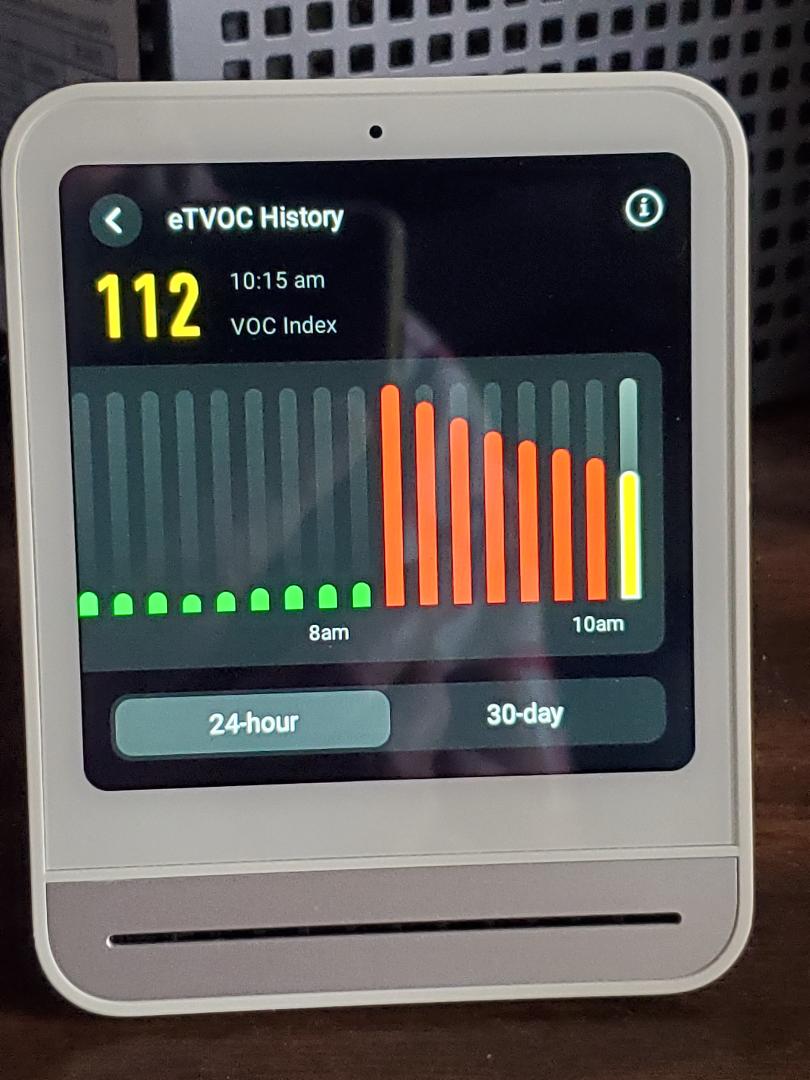
Here is a photo of my qingping monitor showing the VOC index first thing in the morning. Since it hasn’t gone through a 24-hour “calibration” period, it makes absolutely no sense to me. What do you make of it?
Thanks,
MJ
Since the decrease is so constant, I believe the baseline is slowly changing. I would imagine, if you leave it, it will continue to decrease at the same rate until it shows a very steady green/‘good’ level. If you left it running, was that the case?
How are your other pollutants looking (primarily PM2.5)?
Hi Ethan,
Thanks for the reply. To answer your question, PM2.5 has usually been green/good, occasionally yellow, but not higher. The same for CO2, i.e., usually green and occasionally yellow and never too high.
It doesn’t make sense if the 24-hour base line is constantly re-establishing itself (like a running 24-your average) that there should be any sudden jumps in the history, up or down.
Meanwhile, I’ve read that even old carpet can put out significant VOCs. And I wonder if that happens in response to my raining the temperature in the apartment. Do you think that’s possible?
TIA,
MJ
Apologies for the late reply - I took some time off for the holidays I hope you’ve had a good New Year!
If PM2.5 and CO2 are usually good, I wouldn’t worry too much about the VOCs. There are all the issues we’ve already discussed here, and to add to that, Qingping also has some further processing going on that makes the readings so hard to interpret.
It could definitely be possible. Out of curiosity, how do the VOC readings look when you compare them to temperature? Do they tend to rise and fall together?
Thanks for the reply.
To answer your question, I haven’t paid much attention to the VOC readings lately. Especially after seeing the crazy way the reading jumps, as show in that photo, and after reading about how they get their baseline by using a previous period. It really makes no sense.
I have tried to not use the heater much and I think that makes some difference. Winter has just started in this hemisphere. I think that could cut the VOCs from the carpet. The heater isn’t the most high-tech thing in the world, just a gas heater vented to the roof.
I’m relying more and more on my nose to monitor the air here.
Best,
Mark