Originally published at: AirGradient ONE Review - An Open-Source, Affordable Air Quality Monitor
With more indoor air quality monitors becoming available every day, it’s becoming more and more difficult for monitors to differentiate themselves from one another and offer competitive advantages. In fact, while I’m happy to see so many choices now on the market, I often feel like there isn’t that much of a choice at all. This is down to the fact that most indoor air quality monitors offer a similar set of features and have few differentiating factors. This issue is only compounded by the fact that nearly all monitors on the market use sensors from the same companies, making…
I have been doing some temperature/RH accuracy testing with my AirGradient monitors, and I’ve heard of a few issues with the sensors. However, so far, they seem to be performing quite well.
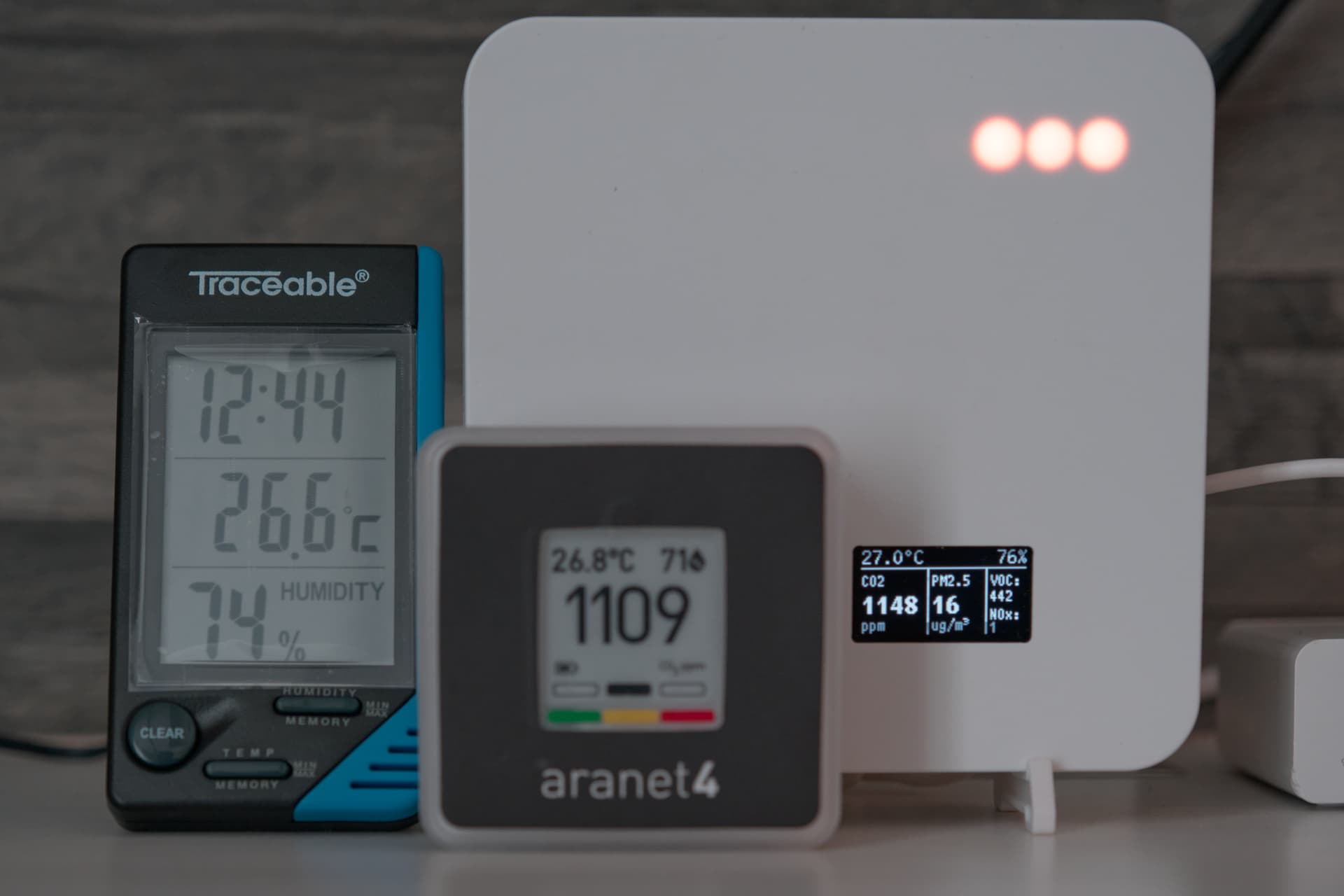
I’ve been using the Traceable 4040 as a baseline which has some variance itself. So far, I’m impressed with the results.
Hey Ethan, do you happen to know how often the values on the screen update? And in the dashboard?
Hi @Setup,
I would need to double-check this for you, but they’re both quite frequent. Since there is no data/power restriction on the ONE, it sends data to the dashboard I believe every minute or so. The values on the screen change more frequently.
1 Like
November 24th, 2025 update changelog.
Today, I am updating this review. Here is a full list of changes I’ve made to the article:
- Added new images
- Changed rating from 4.5 to 4 stars. Mostly due to some persistent issues that remain with the device.
Added paragraph: At this point, I did notice my first issue with the assembly. The screws used are Torx T6 (basically, a little star shape). While I understand that these are technically superior to normal Philipps screws, not many people have the right screwdriver just sitting around the house. But, the screwdriver is included, right? Yes, but it’s a little screwdriver and it’s quite flimsy, making screwing the device together a bit difficult at times. The biggest issue, however, comes when you need to disassemble the device to replace components, but more on that later.
Reason: I’ve had a lot more experience both myself with the AirGradient ONE and hearing from other customers and I’ve realized the screws can be quite a pain point at times. I’ve managed to strip a few of these screws myself.
Added paragraph: Before moving on, one more note: if you’re interested in an even more DIY experience, AirGradient also offers files for printing both the PCB and case on its website. Since the components (outside of the mainboard) are all readily available on most large e-commerce sites, you can easily make your own device and flash AirGradient firmware if you’re interested!
Changed paragraph: While the PMS5003 is generally accurate for PM1 and PM2.5, it’s important to note that it shouldn’t be trusted for PM10 concentrations. This is a problem across all low-cost sensors, and it stems from the fact that they estimate PM10 concentrations based on the PM2.5 (or sometimes PM1) concentration. This is a physical limitation of the sensors, and it shouldn’t be a point against AirGradient, but you should be aware and only interpret the PM10 readings with a grain of salt.
Reason: low-cost sensors are pretty bad when it comes to PM10. I wanted to make this clearer.
Added paragraphs: Before moving on to carbon dioxide, it’s important to mention a few more things. Firstly, all assembled (and only assembled) monitors come with a digital test report that shows how the device performed when tested against a regulatory-grade Palas Fidas monitor. On top of the testing, a custom correction (individual to every monitor) will be applied to bring the monitor in line with the reference. I myself documented exactly how this process works and its upsides and potential flaws in this article.
After extensive research, the AirGradient team also found that each batch of Plantower sensors exhibits similar characteristics and that batch-wide corrections could be created to enhance the accuracy (and precision) of all sensors - including those used in the kits. In other words, while the kits won’t come with individual reports and corrections, you can apply a batch-wide correction via the dashboard to improve performance. You can learn more about this process here.
Reason: new changes that weren’t mentioned in the first review.
Changed paragraph: The S8 has a stated accuracy of ±30ppm ±3% of reading, which is among the most accurate CO2 sensors (which generally vary from ±30ppm ±3% of reading to ±50ppm ±5% of reading). The Senseair S8 (and the newer S88) are both very trusted sensors and they are based on NDIR technology which is the gold standard for everything from consumer-grade devices to professional tools.
Added paragraph: Regarding VOCs and NOx, the AirGradient ONE is accurate within ±15%, however, it’s important to note that the device should not be trusted to give absolute values. Sensirion and Bosch (who make the most popular and common VOC sensors) have both moved to using relative indexes for both VOCs and NOx. In other words, these sensors should only be trusted to show relative, short-term changes and they won’t be able to identify longer-term trends.
Reason: VOC and NOx readings shouldn’t really be trusted past being used for short-term trend analysis.
Added paragraph: With all of this said, the screen is not perfect and I’ve heard reports that many users find it hard to read due to it being so small. While I don’t have this issue myself, I can understand as the screen is indeed very small. If you’re visually impaired, please keep this in mind because it might be challenging to read the figures on the screen.
Changed paragraph: When you go to the shop page for the AirGradient ONE, you will see that it comes with ‘12 months data platform/dashboard access’. This is a bit worrying to see, but it’s important to note that the dashboard will always be free to use. However, after the first 12 months, you can pay $2 (per monitor, per month) to access the premium dashboard. This is fundamentally the same experience, but it means you will get more data retention and some features like the ability to set more alarms than the standard dashboard limit.
Added paragraphs: As of late 2025, AirGradient also has an official Home Assistant integration and it is fully certified as ‘Works With Home Assistant’. This basically means it has the highest level of integration with the platform, and it should work flawlessly. This is fantastic news, because it means that, for people with Home Assistant setups, the device can that much more powerful. While it isn’t within the scope of this article to discuss how Home Assistant works, it’s a great platform if you want to customise how you view the data and set up home automations. For this reason, the AirGradient ONE is my most recommended Home Assistant monitor alongside the Apollo AIR-1.
If you’re in the Homey ecosystem, AirGradient also has a native integration there and I’ve used my device with Homey for over one year. While it doesn’t quite offer the same flexibility as Home Assistant (and it’s a lot more expensive), it’s great for people who want the extra flexibility and integrations but who don’t want to invest the time and effort that Home Assistant can require.
Added: Support & Warranty section